SOCIAL MEDIA

Monday, September 27, 2021

Magical and Medicinal Uses of Oregano

oregano, herbalism, herbal remedy, magic, witchcraft, herb magic, green witchcraft, hedgewitch, herb magic, herb magick, magick, magic, occult, wicca, wiccan, pagan, neopagan

Gender: Feminine/Masculine (depending on tradition)
Planet: Venus/Mercury (depending on tradition)
Element: Air
Powers: Health, Joy, Love, Luck, Protection, Psychic Dreams
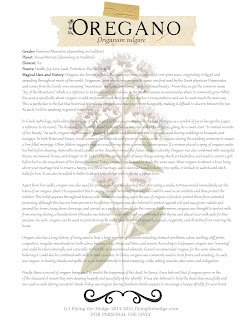
Magical Uses and History: Oregano, also known as Wild Majoram, has been cultivated for over 3000 years, originating in Egypt and spreading throughout much of the world. Origanum, from which oregano gets its name, was first used by the Greek physician Hippocrates and comes from the Greek oreos meaning "mountains" and ganeos meaning "joy/brightness/beauty." From this, we get the common name "Joy of the Mountains" which is a reference to its beauty and abundance in the Mediterranean mountainsides where it commonly grew. While this post is specifically about oregano or wild marjoram, sweet marjoram has similar correspondences and can be used much the same way. This is partly due to the fact that historical records use oregano and marjoram interchangeably, making it difficult to discern between the two. As such, I will be speaking in general terms here.

In Greek mythology, Aphrodite, the goddess of love, is said to have grown oregano on Mount Olympus as a symbol of joy in her garden (again a reference to its name). The Romans, on the other hand, believed Venus was responsible for oregano, giving its is sweet scent "to remind mortals of her beauty." As such, oregano was commonly used in love spells and rituals and was commonly used during weddings in bouquets and nosegays. In both Rome and Greece, it was common for the bride and groom to wear a crown of oregano during the wedding ceremony to ensure a love-filled marriage. Other folklore suggests oregano would bring divine a woman's future spouse. If a woman placed a sprig of oregano under her bed before sleeping, Aphrodite would appear in her dreams to reveal her future spouse's identity. Oregano was also combined with marigold, thyme, wormwood, honey, and vinegar on St. Luke's Day, the patron saint of many things among which are bachelors, and used to anoint a girl before bed so she may dream of her future husband. Today, oregano can be used in much the same ways. Wear oregano to attract a lover, hang above your marriage bed to ensure a happy, love-filled marriage, use to decorate candles during love spells, or include in sachets and witch balls for love. It can also be added to baths to attract love or slept with to divine a future lover.

Apart from love spells, oregano was also used for protection. Aristotle observed that after eating a snake, tortoises would immediately eat the leaves of an oregano plant. He acquainted this to curing 'poison' believing that oregano could be used as an antidote and thus protect the imbiber. This belief appears throughout history, with monarchs insisting upon the use of oregano in foods to protect them from potential poisoning, although this has not been proven to be effective. Oregano was also believed to protect against evil and was grown outside and around the home, hung above doorways, and carried as a protective amulet for this reason. Furthermore, oregano was thought to protect milk from souring during a thunderstorm (thunder was believed to sour milk) and was combined with thyme and placed near milk pails for this purpose. As such, oregano can be used in protection spells and rituals to prevent unwanted guests, negativity, and ill-wishes from entering the home.

Oregano also has a long history of being used to heal a large number of ailments including stomach problems, aches, swelling, stiff joints, congestion, irregular menstruation, tooth aches, bruises, colds, stings and bites, and poison. According to Culpepper, oregano was "warming" and could be taken internally and externally to treat the aforementioned ailments. Gerard recommended oregano for the same ailments, believing it could also be combined with milk to treat earaches. In China, oregano was commonly used to treat fevers and vomiting. As such, use oregano in healing rituals and spells, or as an herbal remedy to treat cramping, colds, aching muscles, skin sores, and indigestion.

Finally, there is record of oregano being used to predict the happiness of the dead. In Greece, it was believed that if oregano grew on the grave of the deceased, it meant they were sleeping happily and peacefully in the afterlife. It was also believed to help the dead sleep peacefully and was used as such during ancestral rituals. Today, use oregano during Samhain dumb suppers to encourage a happy afterlife for your loved ones, place on ancestral altars to bring them peace, or use during other spirit work to soothe the spirits you are working with.

Oregano can be used in a number of spells including:
    Protection Spells
    Love Spells
    Dream Magic
    Healing Spells
    Ancestral Veneration
    Spirit Work

Medicinal Uses: Oregano is a stimulating diaphoretic, being used most often to treat colds and flu. As an expectorant, it is used to treat coughs and other respiratory infections. Its antiseptic properties make it great for treating mouth sores and throat infections as well as cuts and wounds. Furthermore, oregano oil can be used to treat tension headaches, as well as muscle aches and rheumatic pain. It is a mild emmenagogue, meaning it stimulates menstrual flow, so oregano should be used sparingly if you are pregnant or wishing to become pregnant. 

Preparation and Dosage: For internal use, combine one cup of boiling water with 1 teaspoon of dried oregano and infuse for 10-15 minutes. Drink up to three times a day. To create a mouthwash, pour one pint of boiling water over two tablespoons of oregano and let infuse for 10 minutes. Reheat the mixture each time you plan to use it and gargle up to four times a day as needed. As a tincture, take 1-2 milliliters up to three times a day. Externally, oregano oil can be used to treat minor skin irritations, stings, cuts, bruises, and pain. Fill a small mason jar 3/4 of the way full of dried oregano and cover with a carrier oil of your choice. Infuse in a sunny window for 4-6 weeks before straining. Use the oil up to three times a day. Oregano can also be used in poultices for the same reason.


Want to print a copy of this for your Book of Shadows? Click below for your free copy! 
oregano, herbalism, herbal remedy, magic, witchcraft, herb magic, green witchcraft, hedgewitch, herb magic, herb magick, magick, magic, occult, wicca, wiccan, pagan, neopagan


If you liked this post and would like to support future content, please consider leaving a small tip in the jar. 

Wednesday, September 22, 2021

Mabon/Fall Equinox Altar 2021

Autumn Equinox, altar, sabbat, Mabon, August Eve, witchcraft, witchy, hedgewitch, pagan, neopagan, wiccan, wicca

The Fall Equinox, also known as Mabon, is the second harvest festival celebrated sometime between September 20-23. This year, the Fall Equinox falls on September 22nd. Sometimes referred to as Pagan Thanksgiving, this is a time of abundance and celebration. Fruit and vegetables are rapidly ripening in the fields, leaving us with more food than most of us can eat. Grapes, squash, peppers, potatoes, sweet potatoes, figs, carrots, and a host of other fruits and vegetables are ready to be picked and canned for the long winter ahead. This overabundance was something to be celebrated, with the land and Sun being thanked for the bounty our ancestors received. Offerings were often left to the spirits of the fields and agricultural deities in thanks as a bountiful crop now meant our ancestors would be able to eat through the winter months. If the crop failed, so too would the family come winter. Much like Thanksgiving celebrated in the United States and other countries, this is a time to be thankful, count blessings, and give back to those in need. If you are looking for some pagan-friendly charities to support, check out my list here

This year's altar sticks to the general theme of the sabbat, from abundant harvests to general prosperity to the beginning signs of fall. This altar is simple yet effective and is designed to honor the Earth and Sun and ensure the abundance continues for a few more weeks.

Autumn Equinox, altar, sabbat, Mabon, August Eve, witchcraft, witchy, hedgewitch, pagan, neopagan, wiccan, wicca

1. Harvest Candleholder with Green Candle- This harvest candleholder has graced my Mabon altar for several years now and for a good reason. It represents the bounty of the season with its pears, apples, grapes, and berries aplenty. The earthen tones and colorful leaves represent the beginning of Fall and the changing of the seasons as the Wheel turns. This year I put a green candle in it to represent abundance, specifically agricultural abundance. It also works to sympathetically encourage the continued growth of the crops lest harvests do not last through the Winter months. Green also represents the Earth and the gracious gifts she bestows upon us during the harvest, for without her nurturing soils, we would not have nutrient-rich foods. (Where did I get it: Goodwill & Dollar Tree; Cost: $3)

Autumn Equinox, altar, sabbat, Mabon, August Eve, witchcraft, witchy, hedgewitch, pagan, neopagan, wiccan, wicca

2. Leaf Candle Holder with White Candles- The leaf candle holders are an ode to the season and the changing leaves that herald in Fall. Their orange color represents attraction. In this case, it is used to attract the Sun and keep Him burning bright within the sky for a little while longer so the rest of the crops may ripen. In conjunction with the candles, which represent the Sun who is slowly waning in the sky, they work together as a sympathetic form of magic. Furthermore, having two of them represents balance as during the equinox both day and night are balanced. (Where did I get it: Dollar Tree 2017; Cost: $3, $1 each)

Autumn Equinox, altar, sabbat, Mabon, August Eve, witchcraft, witchy, hedgewitch, pagan, neopagan, wiccan, wicca

3. Corn Dolly- The corn dolly/maiden represents the harvest and the spirits of the fields. While traditionally placed on a Lammas altar, I put her on my Mabon altar to represent Mother Earth and the spirit of the Harvest and fields. The effigy is sacrificed the following Spring to ensure a bountiful harvest the following year, but I keep mine year to year to bring abundance into my life. (Where did I get it: House of Rituals Box 2018; Cost: ~$5)

Autumn Equinox, altar, sabbat, Mabon, August Eve, witchcraft, witchy, hedgewitch, pagan, neopagan, wiccan, wicca

4. Adventurine and Amber- In the center of the altar are three crystals, two green aventurine and an amber. Green aventurine is a crystal of balance and prosperity, both characteristic of Mabon. By having two, they also represent balance as the equinox is a time of equal day and night. The amber crystal, however, represents the Sun, fire, fertility, and abundance. (Where did I get it: Metaphysical Stores; Cost: ~$4)

Autumn Equinox, altar, sabbat, Mabon, August Eve, witchcraft, witchy, hedgewitch, pagan, neopagan, wiccan, wicca


TOTAL COST: ~$15


Like my other altars, most of the items I use are found, made, or purchased for around $1, although if the items must be purchased by you, then the cost will be higher. I hope you find this sort of breakdown helpful, especially for those of you looking to create Instagram-perfect altars on a budget! This particular altar is mostly constructed with items I found in my garden, which brought the cost down this time significantly. The most expensive items are the crystals, which can be found cheaply with imperfections at many online retailers.

Autumn Equinox, altar, sabbat, Mabon, August Eve, witchcraft, witchy, hedgewitch, pagan, neopagan, wiccan, wicca

Did you do anything special for Mabon this year? I plan on making one of my favorite pasta dishes tonight for dinner, picking some more peppers from my garden, and enjoying the last of the warm weather, and being thankful I am healthy during these trying times. If anyone is looking for some Thai peppers or habanero peppers I have more than I will ever eat! May your harvests continue to be fruitful, both literally and figuratively. 


If you liked this post and would like to support future content, please consider leaving a small tip in the jar. 

Monday, September 20, 2021

How to Write Your Own Correspondences to Enhance Your Spellcrafting

correspondences, spellcrafting, spells, rituals, witchcraft, pagan, neopagan, wicca, wiccan, witchcraft, spell writing, magick, magic

Most spells use multiple ingredients to lend energy to them. This is a great way to boost the energy of the spell and amplify the magic while focusing on your intention without completely draining your own energy. When adding herbs, crystals, candles, and other objects to a spell, you have to consider their correspondences. But what is a correspondence?

Correspondences are the energies associated with specific objects that can be used to enhance your spell's effectiveness and potency while lending extra energy. These energies are based on a number of things, including history, medicinal uses, culinary uses, colors, and nature. If you were to pick up any book on witchcraft, you are likely to find at least one or two lists of correspondences for commonly used objects, especially herbs and crystals. While most correspondence lists are great, there are always those that include questionable correspondences so it is incredibly important to research any correspondences you are unsure about. You don't want to end up using sunflowers in a spell designed to fight insomnia or rosemary in a spell to forget. While I fully support the use of these lists, especially for new practitioners, how do we move away from them, especially those where we are unsure of where the information originated from?

Writing Your Own Correspondences

When determining the correspondence of an object, there are five methods that can be employed:
  • practical use(s) of the object
  • historical use(s) of the object
  • scientific nature of the object
  • your intuition
  • consulting with the spirit of the object

These methods can be used individually, but I have found that a combination of methods creates a more complete profile of the object. These are the same five methods that I use when writing my Herbarium posts or creating crystal infographics.

The easiest way to start writing your own correspondences is to look at the practical uses of the object. How is the object used in your day-to-day life? What is its function in the household? Let's take the broom for example. The practical use of the broom is to remove dirt and debris from the home. As such, brooms can be used for cleansing a space. If you are looking at a plant, is it used in cooking? What does it taste like? What does it bring to the dish? Is it able to thicken, color, or bind the ingredients together? If it is used medicinally, what is it used for? Does it treat pain, soothe rashes, increase attention, aid in sleep, or treat infections? For example, cayenne peppers are spicy, bringing lasting heat to the dish. They are also used medicinally to speed up digestion and boost one's metabolism and relieve pain. Based on these practical uses, cayenne can be used to bring lasting speed to a spell, burn away the competition, or heat up your love life. From these practical uses, we can start to infer some of their elemental correspondences as well. Cayenne peppers being spicy and red are associated with the element Fire, while the broom, which is grounding and cleansing, is associated with Earth.

Once you have gone through the practical uses of an object, you can start digging into its history. Folklore abounds on most objects we use in our day-to-day lives, especially anything found in nature. I suggest looking at folktales, myths, urban legends, medical texts, and other historical texts to begin determining other correspondences for an object. When looking back at the broom, we find a number of texts alluding to witches using brooms to fly, so the broom is therefore associated with astral travel and flight. Other historical texts discuss women using broom handles to masturbate after many countries ban the sale of dildos, so the broom is also seen as a phallic object that can be used in spells for lust and sexuality. This part of determining correspondences is time-consuming and requires critical thinking, but is well worth it.

Next, begin looking at the scientific nature of the object. This is most easily done with objects found in nature, such as plants, rocks, fungi, animals, insects, and other living and non-living things found naturally where you live. Where is the object normally found? What properties or characteristics does it have that are unique to it? What is its purpose within the ecosystem? Does it have any unique behaviors? Take mint for example. Almost all members of the mint family grow quickly and abundantly. They will take over your entire yard if you aren't careful. Their prolific nature associates them with abundance, prosperity, and fertility. Sometimes these scientific correspondences are easy to deduce, while other times you will need to do a little research. The chokecherry in my yard produces toxins to prevent herbivores from decimating this low-growing tree. This makes it perfect for use in protection spells and magic, even cursing if you are looking to poison someone's mind or relationship or get them to stop gossiping as eating the cherries can cause gasping and respiratory failure. Looking at the plant, you'd have no idea it was toxic, but a little bit of research will clue you in.

While the first three methods rely upon logic to determine an object's correspondences, your intuition relies upon your psyche and emotion. Our modern society often diminishes the reliability of one's intuition and downplays its effectiveness, but this is one of the best tools in a witch's arsenal. To use your intuition to determine correspondences, begin by meditating with the object by wrapping your consciousness around it. What is your gut telling you about the object? What thoughts, images, or feelings arise when thinking about the object before you? This is where personal correspondences often develop. For example, I had a really bad experience with basil pesto while sick, so when I think about basil, I get nauseous. Medicinally, basil is used to treat stomach spasms and help relieve vomiting, but it made me extremely ill. When meditating with basil, this memory always comes to mind, so I associate basil with vomiting, despite its logical correspondences. As such, you will find me using basil to get people to spill their guts metaphorically speaking. This isn't a common correspondence and one that I would not include in something like my Herbarium pages as this is personal, but that doesn't make it wrong or ineffective. Quite the contrary. Your personal relationship with an object and the correspondences you develop by using your intuition are incredibly powerful, at least for you. It would make no sense for my best friend to use this same correspondence as she has never had an ill experience with basil. In fact, we talked about this a couple of weeks ago when she ordered pesto as the base for her pizza.

Finally, you can communicate with the spirit of the object to determine its correspondences. Animism is the idea that all objects, both living and non-living, contain a spirit, a spirit we can communicate and develop a relationship with. This is easier said than done and you must be able to discern between your own intuition and mind chatter before attempting this sort of communication. Some witches, especially new witches, will struggle with this method of correspondence determination, and that's okay! This is a great opportunity to practice and grow your spiritual abilities. Just like using your intuition to determine correspondences, begin by grounding and meditating with the object in question. However, instead of reaching your mind into the object, leave yourself open. Try to keep your general mind chatter quiet and focused on the task at hand. Go in with the intention to listen, not speak. I find closing my eyes or looking at the floor helps focus my mind on a single point so that I may listen better. I do the same thing when intently listening to a person speak. Depending on the object, you may hear it speak clear as day, in complete sentences or you may receive nothing more than a flash of color or a feeling. The key here, however, is to go in with no expectations. You are not owed a conversation with the object, so it may not speak to you at all. However, you can enhance the likelihood that the object will speak to you by developing a relationship beforehand. Leave it offerings, talk to it, tend to it, etc. Basically do the same things you would do to make a new friend, but remember, they owe you nothing in return.

These five methods combined will leave you with a powerful sense of how to use the object in your own magical practice. Furthermore, it will strengthen your magical practice as a whole and solidify your relationship with the object, making it a more potent ingredient in your spells. If you are able to connect with the spirit of the object, it will be much more likely to aid you in return.

Finding Substitutions

Sometimes you want to do a spell, but you don't have all the ingredients. This is especially true of spells you may find in books or online. Let's be honest, some of us just can't buy a bunch of obscure ingredients we are unfamiliar with, don't have the money for, or can't find in our area. This is where substitutions come in. Now before I jump into these, I want to make it abundantly clear that the idea that you can use clear quartz and rosemary in place of any crystal and herb in a spell is fundamentally flawed. This idea completely flies in the face of correspondence magic. However, that doesn't mean you can't rely upon the general idea of it. For most spells, you can easily use clear quartz and rosemary as they correspond with most major intentions, but there are always exceptions to the rules.

General Substitutions:
  • White candle for any color candle
  • Clear quartz for any crystal
  • Rosemary for any herb
  • Table salt for any salt
  • Tap water for any water
  • Rose for any flower
  • Apple for any fruit
  • Olive oil for any carrier oil

I use many of these substitutions all the time, especially tap water and table salt. Those are what I have on hand so that is what I use. The reason these items work is because of the sheer number of correspondences they have, but again, that doesn't always mean that can be used in any spell. For example, you aren't going to want to use rosemary in a spell to bring money because rosemary doesn't correspond with money. You don't want to use a white candle to banish or a rose to aid in astral travel.

When looking for a substitution, consult the correspondences you have created. Is there another item you have on hand that will suit your needs? Don't have mugwort for astral travel? Try dandelion. Don't have a chalice? Use a cup. Get a little creative here, but keep the general correspondences of the objects in mind when making substitutions in your spells.

***

For this week's exercise, I encourage you to sit down with your favorite plant or crystal and begin developing your own correspondences using the methods outlined above. Write down some possible substitutions for this object as well. Once you've gotten the hang of it with an object you love, pick 3-5 objects you use often in your practice and develop their correspondences and substitutions. Finally, pick 1 object you are unfamiliar with and do it all over again. This may be something you own but haven't used or something you find outside your home. By working your way up to an unfamiliar object, you'll be well-prepared to continue writing your own correspondences, no matter the object! 

If you liked this post and would like to support future content, please consider leaving a small tip in the jar. 

Monday, September 13, 2021

Book Review: Kitchen Witchery by Laurel Woodward

book review, pagan, neopagan, witchcraft, witchy, book, witch life, kitchen witchery, kitchen witchcraft, food magick, food magic, cottage magic, cottage witchcraft, cottage witchery

Disclosure: Some of the links below are affiliate links, meaning, at no additional cost to you, I will earn a commission if you click through and make a purchase. I received a free copy of this book in exchange for an honest review.
 
As we move into Fall, I find myself more inclined to cook at home. Georgia heat makes it difficult to want to cook, let alone eat in the first place unless, of course, it's some cool, crisp watermelon while you lounge in the pool or a juicy tomato sandwich with a thick layer of mayo and pepper. When I was asked if I would like to review Kitchen Witchery: Unlocking the Magick in Everyday Ingredients by Laurel Woodward, I jumped on the opportunity to expand my kitchen witchery skills just in time for Fall!

Kitchen Witchery is outlined like a correspondence book with chapters on different food groups, including vegetables, fruits, spices, drinks, wheat, and even gluten-free options. Woodward's book flows easily from one chapter to the next, outlining the correspondences, brief history, and even some nutritional information about each food item. I loved what an easy reference this book is, making putting together the perfect recipe for your desired intention quick and simple. Furthermore, Woodward includes all of her references throughout the book, each one annotated beautifully at the bottom of the page where the source is used. I cannot express how much I love this. Having the source cited right where it is used makes it so easy for me to fact-check and cross-reference any new information I come across, without having to try and dig through the bibliography at the end of the book. I am excited that more and more authors and publishers are following this design. In the age of misinformation, citing your sources is invaluable to lending credibility!

Within each chapter, Woodward includes recipes and ways to use different food items in your magical practice. The recipes were delightful, and very few contained meat, so if you are vegetarian, you have lots of options. If you are vegan, like me, you will have to get a little creative, but we are used to that, now aren't we? As I mentioned above, there is an entire section dedicated to gluten-free grains and recipes. This, on top of the abundance of vegetarian and vegan options, makes the text extremely accessible to all people, no matter their dietary needs. Some of the recipes are outlined under the food's correspondences, while others are outlined in a designated section within the chapter. This can make some referencing difficult, but the index is comprehensive which will help resolve this issue. Furthermore, there are a number of spells and rituals throughout the book that incorporate food that are not edible. For example, there are recipes to make black salt, anointing oils, cascarilla powder, and even some bath recipes. I really enjoyed the mix of edible and nonedible spells throughout the book, as kitchen witchery is so much more than eating.

The beginning of the book covers some basics of witchcraft, including the moon phases, grounding, and meditation, while the last chapter includes a breakdown of the eight sabbats and recipes for each of the seasons. These sections were a great refresher and Woodward's section on the moon phases offered some new insight I can use in my own practice. However, Woodward does promote the myth that crime and hysteria increase during the Full Moon. There is zero scientific evidence to support this claim, so I really wish we would stop perpetuating it as a community.

Despite how much I loved the majority of the book, there is some serious food shaming throughout. It is most notable in the very first chapter, and I had to put the book down and go for a run to release some of my anger. Lately, I have noticed a growing number of witches discussing how the witch community hates poor people, and this is a prime example of witchcraft hating poor people. First, Woodward states that the best ingredients are those that are organic and touts that non-organic food simply isn't magical enough. This idea completely disregards that 1) organic food is outrageously expensive and 2) that food deserts exist all over the world. This means that organic food is simply not accessible to the majority of the world, nor is it really sustainable. The fact that she can afford to feed her family all organic is a privilege, one many people do not have. There is magically no difference between a conventionally grown apple and an organic apple, at least in my experience. Furthermore, Woodward knocks canned goods on the grounds that they contain BPA. Only about 10% of canned goods worldwide still contain BPA. We have moved away from its use due to it being found hazardous to our health. Canned foods are canned at the peak of freshness, meaning that they will contain more nutrients than those obtained out of season. There is absolutely nothing wrong with using canned goods; the food is just as magical as fresh. The idea that everything needs to be fresh is another sign of privilege: the privilege to have the time to make everything from scratch. As an extremely busy person with severe anxiety and depression, the least of my worries when feeding myself is whether or not I make it fresh, from scratch. The goal is to feed me. We need to have a serious conversation about low-energy, budget-friendly, kitchen witchcraft, using the resources and time that we have, instead of food shaming and hating on the poor, disabled, and mentally ill people. The last thing I would like to address is the idea that organically raised cows are happier than conventionally raised cows. Organic does not mean free-range, and even free-range simply means they are not kept in a cage. All organic means is that the cows are fed a diet that is organic. Woodward also claims organically-fed cows are not given antibiotics. This is untrue. If a cow, or any livestock for that matter, becomes ill with a bacterial infection, they will receive vet care and be given antibiotics. However, the laws in almost every industrialized country state that any animal given antibiotics cannot go to market until the antibiotics are out of its system. This means the milk from a cow on antibiotics does not go to market but is instead thrown out. This is true of all livestock. You see chicken in the store that says "No antibiotics!" This is a marketing tactic. None of the chicken in the store in the US can legally contain antibiotics, and the same goes for our milk. It's disheartening to see this misinformation continuing to be spread, especially in 2021. Most of the food shaming and privilege is easily avoidable by disregarding the first chapter and ignoring it in the proceeding chapters. However, the parts where Woodward forgets her audience isn't entirely heterosexual women are harder to ignore. I encourage you not to let Woodward's opinions get in the way of you creating some truly magical recipes in your kitchen, however.

Despite my dislikes, this is one of the most comprehensive kitchen witchery books on the market. I highly recommend it to anyone interested in adding some magic to their kitchen or those looking to expand their kitchen witchery beyond the basics. Kitchen Witchery: Unlocking the Magick in Everyday Ingredients by Laurel Woodward is an excellent correspondence book, one that I will return to time and time again as I add some own magic to my kitchen. Kitchen Witchery: Unlocking the Magick in Everyday Ingredients by Laurel Woodward is available now wherever books are sold. 


If you liked this post and would like to support future content, please consider leaving a small tip in the jar. 

Friday, September 10, 2021

Magical Properties of Aquamarine

aquamarine, witchcraft, crystal magic, witch, wiccan, wicca, pagan, neopagan, occult, gem, stone

If you liked this post and would like to support future content, please consider leaving a small tip in the jar.