SOCIAL MEDIA

Showing posts with label Bone Magic Series. Show all posts

Tuesday, October 22, 2019

Bone Magic Series: Throwing the Bones + Build Your Own Bone Tarot

Bone Magic Series: Throwing the Bones + Build Your Own Bone Tarot

Bone throwing is one of the oldest forms of divination and can be found across multiple cultures throughout history. Because of this, there are multiple ways to practice throwing the bones and ways to interpret their meanings. If you come from reading traditional tarot or runes, you may find bone throwing frustrating and difficult. Unlike other forms of divination, throwing the bones is highly intuitive and bone sets are extremely personalized; no two sets or readers will be the same. Because of this, it's a highly effective form of divination, whether you are reading strictly for yourself or others.

What is Used in a Set?


There are a variety of ways to set up your "bone tarot" set depending upon the tradition(s) you may prescribe to or lack thereof. Most sets consist of bones, shells, stones, and small curios such as dice, coins, or other little trinkets while some are composed only of chicken bones, sometimes even painted to have different meanings. What the set is made up of is completely up to you and, honestly, not very important. However, the meaning behind each item and the item's relation to each other is important. How did they fall? Where are they located? Are they touching each other? How far apart are they? Together, the set works to answer the question the caster has asked of it.

How Do You Read Bone Tarot?


Again, there are multiple ways to read bones. You can work heavily with your ancestors for a more interpreted reading, relying on them to bring you inspiration while reading the bones. Others with a more scientific mind rely on a more analytical approach, connecting meaning to the pieces based on science and their placement on the cloth. Others still work with the spirits that live in the individual objects, listening to them as they whisper back details. Personally, I like to use a combination of these methods, using my prescribed meanings and the spirits to guide my interpretation of the reading. When you are first starting out, you may find a more analytical approach to be best, because its more like traditional tarot in that the location is associated with a specific question, body part, or event while each piece of the bone throwing set is also prescribed a predetermined meaning, such as a wing bone meaning travel. When it doubt, go with your gut.

Despite the different ways to read bones, many practitioners use some similar techniques. To begin with, a question is always asked. Bone throwing can provide a narrow or wide perspective, depending on the situation, and therefore the question needn't be perfectly worded or specific. Most people find asking a question about something that is weighing heavily on you that you may or may not be able to completely put into words is best. However, if you come with a specific and perfectly worded question, bone throwing will still work just fine and allows for a more focused reading. Once the question is asked, the reader shakes the bone throwing set and casts them. Where you cast them is up to you. Some cast on a hard surface or on a fur or cloth with nothing on it; others on a cloth with designated regions; while others still cast in a design drawn in the dirt. Again, where you cast is entirely up to you. I have thrown on cloth with designated regions and on blank surfaces. I like both methods and choose a surface based on the type of question I am asking. For vaguer questions, I prefer a mat with designated regions. This allows for a more focused reading. If my question is more specific, I tend to ignore the designated locations and focus on proximity and reading left to right. Once the bones are cast, they are analyzed and meaning is prescribed to their placement to offer insight into the question asked. Remember to record all your readings in your journal or Book of Shadows. Sometimes it takes a little while for the full message to come into view, so return to your notes for a couple of days after the reading and add to your notes.

Once cast, there are many ways to read the bones:

Left to Right- The bones are considered on a timeline from left to right, with the bones on the left representing the past, those in the middle the present, and those on the right the future or possible outcomes.
Distance from the Reader- Those closest to the reader represent the past, middle present, and those furthest away represent the future or possible outcome.
Non-Linear Orientation- The items are not read in a linear sequence, but instead interpreted as a whole based on their placement on the surface and to each other. This relies more heavily on spiritual guidance.

Of course, these are only a couple of ways to read and by no means the only ways. I encourage you to use your intuition while reading and change up how you read based on the questions being asked.

How to Construct a Bone Set?


Want to make your own "bone tarot?" Creating your own set is pretty fun, but a little time-consuming. Sure, you can buy a set online, and this is a great place to start, but building your own will create a stronger connection between you and the bones. I've talked to other witches who began by buying a set and removing the items that didn't resonate with them and incorporating items into it that did. There is no right or wrong way to do this, and I am still building my own set!

When you begin creating your bone set, start by setting the intention that you are open to receiving objects for use in divination. Then begin going through items you may already have. Check junk drawers and other places you stash random objects. If there is something small that you've never quite been able to let go of, it may be something that belongs in your bone throwing set. Remember, not everything has to be a bone! In fact, you don't need bones at all if that's what you want. Buttons, crystals, small pieces of driftwood, bottle caps, dice, small carved figures, pieces of cardboard tags, seeds and beans, and a variety of other small objects all work! If it speaks to you and feels right in your set, then it's meant to be. However, I do have a couple of things you should keep in mind.

First, you should have an object that represents you. Generally, this object is slightly bigger than the others. Next, the items in your set should mean something. Think about tarot and rune meanings. There is a card or rune that represents health, wealth, love, family, etc. You want a set to have the same sorts of representations so you can get a good reading. I also suggest you add objects that mean yes and no, evil, and decision (a coin is great for this), but you don't have to have these things.

Below is a list of items you may want to include in your bone tarot and some possible meanings for those objects:

feather- flight, travel, communication, messages from the dead
coin- yes/no
wishbone- luck, prosperity, good fortune
skeleton key- transition, open doors, opportunity, crossroads, decisions
quartz point- amplification, positivity, protection, versatility
amethyst- soul, afterlife, psychic ability
fossil- past, ancestors, perseverance
claw- past, present, or future depending on the size
white shell- purity, hope, innocence
curved bone- yes/no
sors bone- fate, destiny, external influences (this is not an actual bone in the body. Instead, its a term, originating from another form of divination, to refer to the smallest, thinnest, or rarest bone in your set. You do not have to prescribe this meaning to any of your small/thin/rare bones. I personally prefer to work with the bones function in the body to determine meaning.)
human finger- singling out an issue
white river rock- purity, innocence, food intentions
black river rock- banishment, bad luck, evil
barnacle- smothered, overwhelmed, chaos
alligator claw- luck, prosperity, opportunities, success
penis bone- love, fertility, luck
coyote bone- trickery, apprehension, fooled by appearances
bean- growth, fertility, opportunity
buckeye nut- abundance, fertility, luck, achievement, employment
hag stone- protection, spiritual transformation, messages
dice- numbers
button- connection, bonds
tooth- communication, truth, lies, rumors (depending on how it faces)

This list is just to give you some ideas and you should prescribe meaning to your objects based on your intuition. As you gather items, spend time holding them and meditating on them to figure out their meaning. Be sure to keep your notes on each item in your Grimoire or Book of Shadows. Items can be removed or added as you see fit, but always write down what you have removed or added an object so you know what your set contains and the meanings of each object. But overall, have fun with it and practice often. It's a truly magical experience to work with a bone tarot set and will flex that intuitive muscle.


And that concludes my series on Bone Magic! I hope this series has been informative and has inspired you to work with animal remains in your practice. Maybe you'll start constructing your own bone throwing set or set out to find your first animal skull. However you decide to work with animal remains, remember to keep their spirits in mind. Always treat them with respect and honor your contracts with them. Your magical practice will surely benefit.

Interest in the rest of the series? Here's what's to come!

Bone Magic Series

Friday, September 27, 2019

Bone Magic Series: Feeding Your Bones

Bone Magic Series: Feeding Your Bones

Once you start working with the spirits of animal remains, it's important to properly care for them. Routinely "feeding" your bones is one such as to do this. Essentially, when you feed your bones, you are providing the animal spirit within an offering. And it's not just bones you can do this with. If you have an animal spirit attached to any remains, such as fur or shells, feed those spirits as well. How often you "feed" your bones is completely dependent upon the terms and agreements you have with the animal spirit per your contract, how often you work with the spirit, and if its a holiday/full moon/etc.

When you first begin working with the spirits of animal remains, you should have a contract in place that outlines what you both agree to do. Often times this agreement includes a list of preferred offerings, if the spirit wants offerings at all. I've mentioned Coyote a couple of times and you guys have seen his wonderful skull grace my altar and some of my rituals as well. Coyote has never asked for food. Instead, per our agreement, my offering to him is a prominent place in my home with natural light near a window. He was buried on the side of a road for a long time before I found him and all he wanted was to see light again, so I have him placed in my library overlooking the main entrance to my home and a window that lets in lots of natural light. When I ask for his assistance in rituals and spells, he has never once asked for any other form of payment, although I would be more than happy to oblige. He's one of the most loving and easy to work with animal spirits I have ever met, and he is currently the only animal spirit I have residing in the animal remains in my home. The others have since moved on or were never in the remains to begin with.

Other times you will want to feed your bones is when you use them in spell work. The animal spirit is aiding in your spell, ritual, or other magical workings and should be fairly compensated for their work. Just as you don't work for free, you shouldn't expect the spirits you work with to do so either. You may also wish to honor the animal spirits on different sabbats, especially Beltane, Mabon, and Samhain, or every Full or New Moon. Getting in the routine of caring for the spirits you work with will ensure they continue to help and that your magic is all the more powerful. Again, how often you feed your bones is completely dependent on the animal spirit contained within the remains.

But what should you offer? Again, this is dependent on the animal spirit, but some common offerings include milk, honey, wine, beer, bread, fresh fruits and vegetables, and even coins, crystals, and other baubles. Offering them some of your own meal on a holiday is a great way to say thank you as well, especially on Mabon. However, be mindful of the spirit you are working with. You don't want to offer chicken to a chicken spirit. That's a slap in the face and downright rude! Generally, if the organism was an herbivore in life, stick to plant-based offerings. If the animal was a carnivore, offering meat is acceptable. Some animals, like birds and raccoons, love shiny objects, so offering coins, crystals, and other metallic/shiny objects make great offerings for them. Depending on the offering you give will determine what you do with the offering when the spirit is done with it. Coins, crystals, and other baubles should stay near the animal remains until the spirit asks them to be removed. Food, however, cannot stay indefinitely and should be properly disposed of. The best way to do this is to bury it in your yard after use. This returns the nutrients to the Earth and is a great way to honor the animal spirit you are working with. As mentioned in my posts on sabbat spirit work, the food will look like it has been untouched, but energetically the food has been drained. You should not eat it or feed it to a pet. This, again, is rude.

Offerings, however, are just one way to care for the animal spirits you are working with. Taking good care of their remains is extremely important, often more important than feeding them. Be sure the remains are kept in safe places where they will not be easily knocked onto the floor or otherwise damaged. If placed in a prominent location, dust them and their surroundings often. If they are not out in the open, but instead stored away, wrap them in silk cloths and place them in a padded container. Remember to check on them routinely and allow them to "breathe" once in a while. No one likes to be kept in a stuffy box forever. Some remains can even be gently, ritually washed once in a while. To do this, use warm water with some herbs, such as rosemary, lavender, and thyme, and gently wipe the remains with a damp cloth that has been soaked in this mixture. Pelts should also be routinely cleaned and can even be washed. However, be sure to research cleaning methods prior to cleaning and NEVER place the pelt in a washing machine or in hot water. By caring for the remains properly, you are showing respect to the spirit you are working with. In some cases, this may be enough for the animal spirit you are working with. Again, it is completely dependant on the spirit and the contract you have with them.

Overall, you should actively work to care for the spirits and their remains as you work with them. Even if a spirit moves on, you should continue to respect the remains and care for them properly. Spirits do not want to work with witches that are known for being rude, cruel, needy, selfish, or thoughtless. You only receive as much as you are willing to give and spirits generally keep score. How do you care for the remains of the spirits you work with?

Interest in the rest of the series? Here's what's to come!

Bone Magic Series


Thursday, August 22, 2019

Bone Magic Series: Working With the Spirits of Animal Remains: Crossing Over & Contracting

Bone Magic Series: Working With the Spirits of Animal Remains: Crossing Over & Contracting

Now its all well and good to find or purchase animal remains, especially bones, but what happens to the spirit of the animal that originally inhabited those bones, and may still be inhabiting them? Should you help the animal cross over? Contract it? Leave it the hell alone? These are the questions you need to ask yourself and the animal spirit you encounter. Each spirit is different and therefore no two experiences will be the same.

You will most often encounter an animal spirit attached to their remains if you come across the bones in the wild. Unfortunately, animal spirits tend to vacate bones handled by large suppliers, even those I mentioned in my previous post How to Ethically Acquire Animal Remains. Of course, this isn't always the case, but from my experience, purchased remains tend to be spirit free. So what should you do when you come across remains in nature? First, approach the remains with the utmost respect, just as you would human remains. Remember, this was a living creature with its own hopes, dreams, and fears. Close your eyes and open yourself to any spirit that may still be hanging out in the remains. If after a few minutes, nothing speaks to you, the animal spirit has likely moved on. If you choose to take the remains, thank the animal, even though they are not there for other spirits are watching you, for the gift and treat the remains with care and dignity. You may wish to leave a bit of yourself behind as thanks. Strands of your own hair, a drop of your blood, or some of your saliva are all acceptable offerings.

If the animal spirit still resides within the remains, you have one of three options: help the spirit cross over, contract the spirit, or leave it be. With the proper protections in place, open up your thoughts to the spirit and ask what it would like. If the spirit tells you to bugger off, thank the spirit for its time and move along. Do not come back to the remains later in hopes that the spirit has moved on. It told you no; accept that answer. Just like you have bodily autonomy (or should), so do animals. You have no rights to any of its remains, especially once it has told you no. If the spirit wishes for your aid in crossing over, ask it how best you can help it transition. Depending on how the animal lived and died, they may be extremely fearful, angry, or sad. Listen to what the spirit has to say and try your best to help guide its soul into the other world. So how exactly do you go about doing this?

There are lots of guides online that all suggest different methods. I prefer to simply listen to the animal spirit tell its story. Sometimes that's all the animal needs to do and they will cross over once their story is over with. For those particularly resistant animal spirits, ask them if you can help guide them toward the light. If they say they need the assistance, sit next to the remains and ask if you may touch them. If the animal says yes, place your hand gently on the remains (unless it's a freaking armadillo then don't freaking touch it), close your eyes and call upon your guides to aid you in helping the animal spirit cross over. If the animal does not wish to be touched, simply hover your hand over the remains. Enter into a meditative state and visualize a golden orb of light surrounding you and the animal spirit. This golden orb of light, as you focus on it, will engulf the animal spirit, pull it from the remains, and gently carry it into the Otherworld. Ask the wind and rain to wash away any resentment, fear, or inhibitions and say something like, "May your spirit find comfort and joy on the other side. Go swiftly and safely into the great beyond." The two times I have done this, Meka, my fox animal guide, has come to comfort the animal spirit and aided in their transition. Your animal guides will likely do the same, although you should be cautious if your animal guide is a predator and the animal spirit crossing over is a prey animal. They may be scared of your guide and refuse to leave. Use your best judgment. For some reason, no animal I have encountered, living or nonliving, has been afraid of Meka. Her heart is so absolutely pure and comforting, that everyone feels at ease around her. I would never ask Rocar to assist in a crossing over. He is too abrasive and obnoxious.

If the spirit wishes to remain and doesn't ask you to leave it alone, ask it if it would like to work with you in your magical workings. If it agrees, offer the spirit a contract. Your contract is to protect you and the spirit and make it abundantly clear what each of you should expect from the other. It sets boundaries and rules, as well as lets the spirit know what you will be offering it in return from its services. Sometimes a spirit may want to come home with you simply to be with you and yours. All it wants is a loving home and in return will watch over you and your family. Other times, the spirit will be more demanding. It's okay to negotiate, but be firm in what you will and will not do. Begin with a verbal contract and upon returning home, write the contract within your spirit journal or Book of Shadows. Sign and date and be sure to read it to the spirit and accept their "signature." Their signature can be a "verbal" agreement or you can use a pendulum or tarot cards to exact a yes. For example, 2 out of 3 upright cards indicates a yes while the pendulum swinging to yes or in whatever direction you have determined as yes means, well, yes. Below is an example of what your contract could look like:

"I, [insert name here], enter into an agreement with [name of the animal spirit or species if not given]. In exchange for magical assistance, spiritual advisement, and enhanced magical perception, I offer [insert offering agreement here]. In order to fulfill this contract, [name of the animal spirit/species] shall not require more than what was originally agreed upon without negotiating and shall only work in my favor and for the highest will. Failure to do so will result in the termination of our agreement." (modified from Devon Hunter's The Witch's Book of Spirits.)

Finally, ask if you may take its remains back with you to your house and if it has a particular bone it wants you to take with you. This bone will be the house for the spirit and usually animal spirits prefer their skull, although not always. I have read from other witches that their animal spirits preferred toe bones, teeth, or ribs over the skull. Take only what the animal spirits says you may take. Again, bodily autonomy. Respect the spirit's wishes. Before you clean the remains, ask the spirit if it's okay. I have a coyote skull that has not been cleaned because the coyote said no. Perfectly fine with me.

Working with animal spirits is such a delight. They bring a power to your magic like no other. They are often kind and generous as well as loving and protective of the witches that care for them in death. Remember to always be respectful and in return, they will be some of your best magical allies. Honor your agreement and be sure to offer them what they wish in return. Coyote is happy to sit on my bookshelf among my favorite books, wanting nothing more in return than a prominent spot to watch the going on's in my home. He has been my longest animal spirit companion, going on 10 years, and I enjoy just looking at him among my books when I sit on my emerald green couch to read a good book. Sometimes I even read aloud to him. Have you contracted an animal spirit or helped one cross over? Tell me about your experiences in the comments below.

Interest in the rest of the series? Here's what's to come!

Bone Magic Series

Monday, July 22, 2019

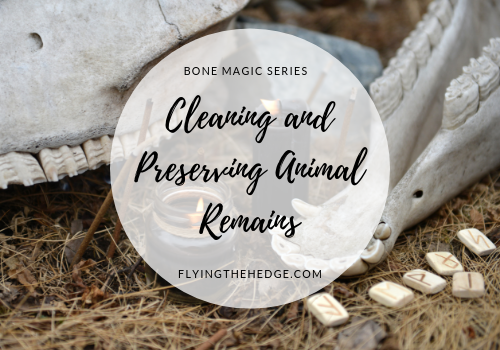
Bone Magic Series: Cleaning and Preserving Animal Remains

Bone Magic Series: Cleaning and Preserving Animal Remains

Now that you have started to acquire some animal remains, you may find yourself wondering how to clean them. Of course, if you buy from an online retailer they will come nice and cleaned to you, but finding them in nature is another story. I have some bones I have found that I haven't cleaned because I loved how they looked and the animal spirit residing in the bone or skull wished for it to remain just the way I found it. The coyote skull I have is one such example. If you have seen it in my rituals, spells, and altars, the skull is covered in lichen. Eventually, the skull will break down, but I respectfully left the skull as it was at the request of the coyote spirit. Other bones and skulls I have, however, either don't have a spirit or the spirit was totally fine with me cleaning their vessel. Always ask before you clean any bones you found. The last thing you want to do is upset the animal spirits or drive them away from their resting place.

So how should you clean the animal remains you find? This is by no means going to be a complete guide, but I have included links to articles and videos to fill in the gaps.

Disclosure: Some of the links below are affiliate links, meaning, at no additional cost to you, I will earn a commission if you click through and make a purchase.


Bones

There are several methods to clean bones if you so wish. Most people agree that bleach, even in low concentrations, is harmful to the bones and will cause degradation over time so you will find no bleach here!

1. Flesh Removal

If you come across bones that still have flesh on them, such as roadkill or bones purchased from a butcher, you need to begin by removing the flesh. You have several options here depending on time, equipment, and smell tolerance!

Slow Cooker Method 1

First and foremost, you don't want to boil the bones. Boiling causes the bones to become weak and brittle, just as cooking them does. I know lots of people used chicken bones from rotisserie chickens, and that is perfectly fine, but the bones are much more brittle and prone to breakage than bones that have not been cooked or boiled.

For the first slow cooker method, all you will need is a slow cooker, slow cooker liner (to prevent the flesh from permeating into your slow cooker and to help with clean up), water, and the remains.  Remove as much flesh as possible prior to cooking. This can take some time and if the remains have begun to rot, this is going to smell horrid. Place the liner in the slow cooker. Sit the remains in the liner and fill with water until the remains are covered. Set the slow cooker to 165° F or the low/medium setting. Make sure to check your manual to figure out which setting will be closest to 165° F.  Again, you do not want to boil the remains. Depending on the size of the remains, it should cook anywhere between 4 and 24 hours. A pig head takes about 24 hours. If it is larger than a pig head, you're going to need to cook it longer, but I can't fit anything larger than that in my slow cooker so you'll likely go with a different method.

After cooking the remains, you will need to remove any remaining flesh and scrub the bones well with dish soap. Nonscoring pads, dish brushes, and bottle brushes are best for this as they won't scratch or damage the bones. Again, this is going to smell horrid, especially if there is any brain left behind. You might want a mask and some candles burning.

Slow Cooker Method 2

This method uses all of the above items as well as a biological washing powder to speed up the process and make the bones easier to clean. A biological washing powder is any powdered detergent that contains enzymes. These enzymes break down the fats and proteins in the remaining flesh, making it easier to remove whatever remains after cooking. To find a biological powder, look for any powdered detergent that contains enzymes (protease) or order some Bio-Tex off Amazon.

As before, place everything in the slow cooker and set your slow cooker to a low setting. Add 1-2 tablespoons of biological washing powder. Depending on the remains, allow to slow cook for 4-24 hours. You want the water to remain warm throughout the process but not hot, otherwise, the enzymes will not activate or will denature. At low temperatures, the enzyme protease will not function. At high temperatures, protease will break down (denature) and no longer work. Once the remains are removed from the slow cooker, be sure you wash them really well to remove all the enzymes and remaining flesh. You don't want the enzymes to continue breaking down the bone!

Maceration

This method is often referred to as the "cold" water method and smells awful, but it is super effective for small remains like fish, amphibians, bats, and mice. You will need a large plastic bucket with a lid or a mason jar for really small remains. Place the animal remains, with as much flesh removed as possible, in the bucket or jar and fill with warm water until the remains are covered. Do not use hot or boiling water as it will kill the bacteria. Cover the container, but do not completely seal it. Lack of oxygen will slow down the process. Sit in a warm location, under a heat lamp (mason jar), or place an aquarium incubator into the bucket set to 95° F.  You want the temperature to remain around 95° F for the duration of the process to help the process. After two days, change the water, leaving some of the original water in the container to maintain the bacteria colony. You can remove flesh from the remains at this time as well, especially if there is a lot of fat left behind. You don't want the fat to accumulate in the bones. One day 5, check the remains again. If there is still a lot of tissue left, allow the remains to macerate longer. This process can take up to 14 days. After 14 days, remove the remains and clean them as best you can.

Dermestid Beetles

If you have space and you know what you are doing, dermestid beetles, aka flesh-eating beetles, are a less smelly way to clean your bones. However, you are going to need to consistently provide your beetles with food, so if you are only looking to clean a few remains, dermestid beetles are not for you. They should also be kept in a large tank with proper bedding in a warm place. If they get too cold they won't eat. Furthermore, dermestid beetles are best for small remains with little flesh. It takes time for the beetles to eat and if there is too much flesh on the bones, the inner flesh will begin to rot. Dermestid beetles prefer fresh flesh to rotting flesh. If you want to use larger remains, remove some of the flesh prior to feeding the beetles. It can take anywhere from a couple of days to a couple of weeks for the beetles to do their work. Once they are done, simply follow one of the cleaning methods below. You can order a dermestid beetle kit here or call local wildlife centers and taxidermists to see if they have beetles open to public use.

Burial

This method is easy, less smelly, but time-consuming and slightly risky. If done incorrectly, you can end up preserving the entire animal, losing bones, or damaging them. If you plan to bury, leave the animal remains above ground for 2-3 days. This will allow flies to lay eggs. Once the larvae hatch (maggots) they will begin eating the flesh, even if buried underground. If you are burying smaller remains, place them in a thin muslin bag to keep the remains together. For larger animals, you might consider a wire mesh. Bury the remains in drier soil. Avoid very wet soil and sand as this can preserve the remains. Mark where you buried the remains and allow them to sit for several months. The larger the remains, the longer they should remain buried.

Laying Out

This is super risky and smelly but effective. Leaving animal remains to rot on the surface do so quickly and effectively, but you run the risk of humans and animals alike making off with your remains. However, Mother Nature is much better at cleaning bones than we are. Simply leave the remains above the surface for 3-12 months depending on the location and size of the remains. You will want to cover them in a wire mesh or cage to prevent animals and humans from taking the remains. Foxes and coyotes will run off with bits and pieces and take them miles away if you're not careful. Another method is to place smaller remains underneath a weighted flower pot. This allows flies to move in and out and keeps predators out.

2. Degreasing

Degreasing the bones is an important step if you used many of the methods above. While you don't have to degrease the bones if you laid them out of buried them, it is still a useful cleaning step so why not do it anyway? Simply mix together warm water and Dawn dish soap and allow the bones to sit in the water-soap solution for 24 hours. This will remove both dirt and fat residue left over from the defleshing process.

3. Bleaching (without bleach!)

There are two methods to "bleaching" or whitening bones. The first is the hydrogen peroxide method, which also helps sterilize the bones. The second is sunning them I do during the drying process. Once you have cleaned and degreased the bones, place them in a container and cover with 3% hydrogen peroxide. This will disinfect and bleach the bones without causing them to degrade. It can take 3 hours to a week for the bones to whiten to the color you wish them to be. Make sure there are no air bubbles trapped and the bone is completely covered.

4. Drying

After everything is said and done, allow the bones to air dry in the sun if possible for a couple of days. If they are not completely dry after a couple of days, place them on some newspaper and allow them to dry near a heat source. Do not place them directly on the heat source as this could cause the bone to crack.

Feathers

Feathers have a very different process of cleaning than bones. They are much more fragile and don't need to have any fleshed removed. You can clean them in a soapy water bath or wipe them down with baby wipes. When you dry them, be sure to rub them back into the correct position and dry them on a flat surface. Do not place in direct sunlight. After washing and drying them, place them in the freezer for about a week to kill any bugs or mites that may still be left on the feathers.

If you are looking at preserving an entire bird wing, try the borax method. In a cardboard box, sprinkle an inch of borax on the bottom. Place the bird wing on top of the borax then cover it with a thin layer of borax. The borax will dry out the tissue and mummify the wing while simultaneously disinfecting the feathers.

Other Animal Remains

Most other animals remain such as teeth, claws, and shells can be cleaning with soap and water. Furs and pelts can be washed in a mild soap and water bath and should be immediately hung up to dry in a warm place. Do not place pelts or furs in the sun as this will cause fading. Organs and organ tissue should be preserved in a preservative fluid as recommended by a taxidermist. If you are looking to use something quickly in a spell, like a fresh sheep heart or cow tongue, usually the spell requires burying or tossing the parts away after use. Store these items in a fridge or freezer prior to use.

Below are some amazing resources regarding cleaning and preserving animal remains.

Cleaning and Preserving Animal Skulls by the University of Arizona Cooperative Extension
Jake's Bones (blog)- Covers everything you could possibly think of regarding cleaning animal remains.
Bones at Home- how to properly care for your bones once they are clean
Sanitizing Feathers for Crafts by Dara Trahan
The Best Way to Clean Seashells Without Ruining Them by Dawn Henthron
Wet Specimens- A General Guide by Mickey Alice Kwapis
Wet Specimens- An Updated Post (with a little history lesson) by Mickey Alice Kwapis
Link Round Up- Bone Cleaning by Mickey Alice Kwapis

Whatever method you chose, always make sure you are following safe procedures and following all local laws. If you are concerned about smell, legality, time, or space, buying bones from an ethical online source is fine. It doesn't make you less witchy to buy them. Do you have a preferred cleaning method?

Interest in the rest of the series? Here's what's to come!

Bone Magic Series


Thursday, June 13, 2019

Bone Magic Series: How to Ethically Acquire Animal Remains

Bone Magic Series: How to Ethically Acquire Animal Remains

So now that we have covered many of the historical and modern uses of animal remains, how do you go about acquiring them? The good news is, you have several options to legally and ethically acquire bones, furs, feathers, teeth, and claws, you just have to know where to look! I understand not everyone has access to large expanses of woods to find animal remains or trekking through a forest looking for bone may not be your thing. I get it! And because of the internet, it's now easier than ever to acquire animal remains, even for those that are against killing animals, like myself.

Nature Walk

This is how I have acquired most of my animal remains, most of which came from my dad who is an avid hunter (well he used to be) and therefore out in the woods a lot! He stumbles on animal remains all the time and brings them all home. I'm fortunate enough to be given many of the things he finds, and I use them as decor and in my magical practice. You simply need to venture out into the woods and keep an eye out. If you are hiking common trails, especially in a park, you're likely not going to find anything because others have been there before you. Besides, you're not supposed to take anything from parks, but I know people do anyway. Find a wild place, where few people travel and walk the local wildlife trails. Deer wear some pretty clear paths through the woods; these are great places to start. Don't be surprised if you don't find anything on your first walk. You'll likely take a lot of walks before finding anything, but that's part of the fun!

Roadkill

This is an easy way to get animal remains, but not a very pleasant one! Furthermore, there are several downsides to using roadkill remains. First, you run the risk of coming into contact with an infectious disease, including rabies and even leprosy! A word to the wise, if you live anywhere near armadillos, like I do here in Georgia, leave their remains right where you find them! They are notorious for carrying leprosy and no one wants to be a lepper, although you'd certainly have that old world witchy vibe going on. Second, many of the bones may be broken or otherwise harmed. Its the side effect of being hit by a car! Third, the animal remains will need to be cleaned of any remaining flesh, and the process doesn't always smell very nice. I'll cover that move in the next post. Please make sure you follow all local laws regarding roadkill. It is illegal in some areas to touch roadkill, but I won't tell.

Hunting/Hunters

If you are a hunter, you can save the remains of the animals you have killed. If you aren't a hunter but don't mind that someone else did the killing, the check out the local animal processing business. Hunting season is year round, meaning something is in season all the time, so hunters are constantly bringing in animals that need to be processed. In Georgia, you can pick up white-tail deer, turkey, wild boar/pig, rabbit, waterfowl, and even bobcat and coyote remains if you get lucky. After they have processed the animal, there are bones and pelts left over. Some of the processing businesses will sell these; some may even give you parts for free! Some smaller businesses are just happy someone is taking it off their hands because a lot of times the unused remains end up in the trash.

Butcher Shop/Grocery Store

There is a couple of option here. One you can buy meat with the bones still in the meat and remove them yourself, or you can ask the local butcher if they have any leftover bones you could buy. Yes, they usually sell the bones here because people like to use them in cooking stock. Keep in mind that cooked bones are more brittle than uncooked bones, but you are more than welcome to use cooked bones. I've seen several witches do it with good results.

Online Stores

Not interested in getting your hands dirty? Not to fear! There are tons of great shops online that ethically acquire animal bones, usually from animals that died of natural causes. Do some research on the companies though. While they may advertise that they ethically and legally sourced the animal remains, you can't be too careful. Be wary of exotic animals and always make sure to check whether or not the animal is listed as endangered. It is illegal to own any remains of an endangered animal unless there is proper paperwork detailing it came from healthy populations or it is from before 1973.

So what shops do I recommend? Curious Nature sources all of their remains from roadkill, zoos, or a byproduct of another industry, such as farming. They purposely try to learn as much as they can about where the remains come from, to ensure they are ethically sourcing their product. You can read more on their stance here. One of the best stores and a personal favorite of mine is The Skull Store. Like Curious Nature, they actively search for ethically and sustainably sources animal remains, not to mention they work with conservation programs, wildlife rehabilitation, and education programs. They never commission an animal to be killed; instead, they purchase animal remains from sustainable sources such as zoos, farms, indigenous peoples, and old collections. Furthermore, they work with law enforcement and wildlife enforcement agencies to help catch poachers and smugglers. You can read their full policy here. This is one of my favorite online sources as they take action in the wildlife community. Another shop I love is Of Moth and Moon. I've ordered from their shop and received some amazing little curiosities. It's a small family business and all of their animal remains come from nature, owl pellets, roadkill, natural deaths, or are the by-product of an industry or pest control. You can request items to come strictly from nature, roadkill, or natural death if you don't want to support an industry that profits from killing animals.

Your Pets

Yes, you can get animal remains from your pets, while they are still alive and well I might add. My cats shed fur, whiskers, and nails all the time. Any of these could easily be used in magical practice. Sometimes a pet may lose a tooth or need to have one extracted. You can ask the vet for that tooth! My chickens constantly shed feathers. I am completely covered up in feathers right now! When your pet passes, you can also opt to have them preserved or use their bones in your practice, if that doesn't bother you too much.

***

No matter how you decide to acquire your animal remains, please never kill an animal simply to harvest something from it. That's highly unethical and the spirit of the animal will not be pleased. Please follow all local laws and regulations regarding animal remains. I think by now most American witches know they aren't supposed to be picking up feathers, but use your best judgment. If you do come across animal remains in nature, approach it with respect and caution. Disease is a big factor, but the spirit may still be hanging out around. If you sense that it is, ask if you may approach and touch the bones. If its a no, simply thank the animal for its time, leave an offering and move along. If it does allow you to touch it, make your intentions clear and known and ask if you may take a bone or several with you for your magical workings. As of yet, I haven't been told no! You may find the bones are empty, especially if they have been there a while. I would still approach respectfully.

How do you find animal remains to use in your practice?

Interest in the rest of the series? Here's what's to come!

Bone Magic Series


Thursday, May 16, 2019

Bone Magic Series: Feathers, Fangs, and Claws: How to Use Them in Magic

Bone Magic Series: Feathers, Fangs, and Claws: How to Use Them in Magic

Previously in the series, I covered bones and skulls and furs and pelts. This is only a fraction of the animal remains witches commonly use, and while this is a bone magic series, I strongly felt the need to cover a variety of animal remains because their uses make more sense with the proper context. This post will discuss all those miscellaneous remains, including feathers, teeth, and claws.

Feathers

Feathers are keratin filaments that cover the outside of birds and even some dinosaurs. They make up the plumage and not only provide warmth and water resistance, but also allow for flight. Like animal pelts and skins, feathers do not preserve well over time, so much of what we know of their historical magical uses stem from indigenous cultures, mostly Native American, and ancient mythology. Feathers have long been used as ornamentation on ceremonial garb, particularly headdresses among many groups worldwide, or as robes and cloaks. Birds are believed to possess a spiritual essence, their feathers being used to aid in flight and communication with the spirit world (source).

The type of bird largely impacted the type of magic associated with the feather. Macaw feathers, desired for their color and highly valued, were used by the Tewa for ceremonial purposes as a way to bring rain, which was believed to come from the South, the cardinal direction associated with the macaw (source). These feathers were so valuable, in fact, that they were often traded for goods, including turquoise and skins (source). Among the Zuni, turkey feathers were believed to represent mortality and therefore not worn by a dancer should death follow. Today, turkey feathers are often buried on All Souls' Day so the dead may wear them to dance (source). Eagles were and are symbolic of the sun or sky and were often used in combination with turkey feathers. It was believed the eagle was a spirit messenger and could take prayers to the heavens. Wearing the feather of an eagle is said to bring strength, wisdom, and protection (source). In the Hopi Snake Dance, a dancer follows the snake carrier while continuously brushing the rattlesnake with an eagle feather to stop the snake from striking (source). In Celtic mythology, the eagle was believed to be one of the oldest of all creatures.  In the tale of Culhwch and Olwen, Culhwch is tasked with finding the magical child Mabon. He asks a number of animals to help him in his quest, the eagle being the animal who tips him off as to where Mabon is (source). The eagle also appears in the Anglo-Saxon Chronicle in an account of the Battle of Brunanburh which says, "...the grey-coated eagle, white-tailed, to have his will of the corpses." This suggests the eagle took advantage of the deaths during the battle, thus again showing wisdom and ingenuity. Furthermore, Highland clan chiefs often wore three eagle feathers in their bonnets as a symbol of rank (source).

Crow feathers, like the eagle, were also used for wisdom and knowledge, as well as death and witchcraft (source, source). The tail feathers of a peacock, in spite of the beautiful plumage, is believed to bring ill luck and attract the evil eye, due to the tip resembling a human eye. Peacocks are scared to Juno, the patron goddess of women, and to rob a peacock of its tail feathers is thought to offend her (source). This, of course, is not a complete list of all feather correspondences but it does drive the point home that feathers have numerous magical associations.

In Egyptian myth, the feather of Ma'at was the judge of one's soul. According to the story, the heart of the deceased was handed over to Osiris, the God of Death, who placed it on a giant golden scale and balanced it against the white feather of Ma'at, the feather of truth. If the heart was lighter than the feather, thus showing it was free from impurities and sin, then the gods would consult the Forty-Two Judges to decide whether or not the soul was worthy. If so, the soul would pass to the Field of Reeds, the Summerland/Heaven equivalent in Egyptian mythology (source). The feather is also the symbol of Shu, the Egyptian god of Air and father of the Earth. Shu is often depicted wearing a feather in his hair. As such, the feather is often associated with the element Air (source).

Ancient Shamans in Siberia and the Druids of Europe often wore birdlike cloaks and costumes to represent transformation. The Colloquy of the Two Sages describes the possession of a three-colored feather robe by a High Bard. "...A covering of bright bird's feathers in the middle, a showery specking of fin-druine (white silver) on the lower half, and a golden color on the upper half." Another similar description is found in Cormac's Glossary, referred to as a tugen which was a Feathered Cloak commonly worn by Irish poets to represent mysticism and knowledge (source).

Feathers are also commonly placed in Witched Ladders. In the late 1800s, several strange items were found in the eaves of a house in England including a string of feathers. The house was then declared to belong to a witch and the string of feathers was referred to as a 'witches ladder.' In this case, it was a string of cockerel feathers and it was suggested to be used to cross over the roof of houses, cause death, and hex neighboring cattle. It was believed each feather was a hex, curse, or bad wish upon another. Throwing the witches ladder into the water was said to break the curse as the water would purify and loosen the feathers from the string. Their removal from the ladder meant the curse was also removed. Modern witches create witches ladders to curse, invoke clarity, or bring positive intent such as luck, prosperity, love, healing, or success with each feather representing a wish (source).

Today, feathers are used in much the same way as they have been historically used. Witches use feathers from an assortment of birds for an assortment of magical purposes. For example, placing blackbird feathers under someone's pillow is said to compel them to tell you their innermost secrets, while the feathers of a Wren are believed to prevent drowning (source). Furthermore, feathers are often placed on altars to represent air or placed in hedge riding sachets to aid in soul flight. Different colored feathers also have a variety of meanings. For example, finding a black feather means an angel is protecting you, green for abundance, and white for purity (source). Finally, many witches use a feather to waft smoke from incense or a herb stick. Their uses are endless and have been used for centuries by magical practitioners around the world.

Teeth and Claws

Other animal remains include teeth and claws (I will cover shells and blood in the future, but not as part of this series). Teeth could be classified under bones, but I felt the need to discuss some of their specific uses separately. Teeth are hard external bones covered in enamel used for mechanical digestion. Some of the earliest uses of teeth, whether animal or human, dates back to burial practices in the 7th and 8th centuries. Amulets containing teeth have been found in numerous graves, particularly those of women and children across Europe. It is believed these amulets were placed in the grave for protection for both the living and the dead (source, source).  From the 7th to 9th century, animal teeth were used to identify cunning women and these bones were commonly buried with the practitioner (source). In the 13th and 15th century, cattle teeth were found in graves, an indicator of healing magic (source).

In Ancient Rome, teeth were highly valued as a form of protection against the evil eye. Giovanni de'Medici was particularly fond of using animal teeth as a form of protection, particularly for the protection of children. Paintings by Detti and contemporary inventories suggest that animal teeth, more specifically wolf teeth, were mounted around homes, including the estate of Piero Ubaldini and Giulio de'Medici. Like many items during the Renaissance, teeth were believed to be a form of sympathetic magic. They were placed around the neck of a nursing infant to protect the child from danger and promote the development and growth of the child's own teeth (source, source).

Later teeth that had fallen out were commonly thrown into the fire instead of kept for protection as it was believed the teeth could be picked up by a witch and used to cause misfortune (source). Still, later the folktale of the Tooth Fairy arose in the United States around 1900. It is important to note that the Tooth Fairy did not exist in British folklore, making this a largely American tradition, although the Italian Marantega and several other folktales around the world are remarkably similar. It was believed that by placing the tooth under the pillow that the fairy would reward the offering with a monetary gift. The tale of Marantega, an old witch who trades coins for teeth, is very similar to the myth of the Tooth Fairy. However, it is believed she seeks teeth to fill her own toothless mouth (source). In several Asia countries, including China, Japan, and Korea, children who lose teeth from their lower jaw would throw their teeth on the roof, while those lost from the upper jaw are tossed on the floor or placed under the pillow. It was believed that the new tooth would be pulled toward the old tooth, lessening the time it would take to replace the tooth. In Mongolia, the teeth were fed to dogs, so that the new tooth would be as strong as the dog's teeth, or buried under a tree so that the new tooth had strong roots (source).

In Conjure, teeth have been historically and still are used in a variety of magical workings. For example, badger and alligator teeth were and are used in mojo bags (source). In fact, in 1760 Jamaica passed an act that forbid the slaves from engaging in magical activities, using dog and alligator teeth as evidence of such magical workings (source). Today teeth are used for protection, to bring luck, in binding spells, as part of a bone tarot set, in mojo bags, or in spells that increase communication.

Like teeth, claws can be used in much the same way, pulling on the attributes of whatever animal it came from. Historically, claws have very little written about them. In fact, much of what I could find is about cutting human fingernails. It was believed that cutting your nails on a Friday or Sunday was unlucky while cutting on Monday was thought to bring good health and Tuesday wealth (source). Romans often wore images of bears or bear claws to ease childbirth and protect the unborn child (source). Today, witches use claws as altar decorations, for protection, and mojo bags. For example, cockerel claws are used in protection charms in Voodoo and Santeria practices.

Overall, animal remains have and are an integral part of magical practices the world over. Whether they are used in rituals or spells, they bring us closer to the world around us. How do you use feathers, fangs, or claws in your magical practice?

Interest in the rest of the series? Here's what's to come!

Bone Magic Series


Monday, April 1, 2019

Bone Magic Series: Furs and Pelts: How to Use Them In Magic

Bone Magic Series: Furs and Pelts: How to Use Them In Magic

Disclosure: Some of the links below are affiliate links, meaning, at no additional cost to you, I will earn a commission if you click through and make a purchase.

In the last post, I covered how skulls and bones are ritually used in witchcraft, both historical and modern. This post will cover the use of pelts, furs, leather, and skin in magical practices through time and across the globe.

Pelts and fur refer to the outside covering of an animal. A pelt is the animal's skin and fur, while the fur alone is no longer attached to the skin, such as when you brush your dog or cat. Also included in this category would be animal skins, such as snakeskin, leather, and wool. These make up the outside covering of the animal, being used for touch, protection, and temperature regulation. The skin contains hundreds of thousands of nerve endings, thus making the skin one of the first ways an animal interacts with the world. Furthermore, skin and fur act as a protectant, keeping in moisture and harmful pathogens. Finally, the skin is used for temperature regulation, providing an anchoring site for sweat glands, as well as for fur to aid in warmth. Animal remains other than bones don't tend to preserve very well, so much of what we know regarding the use of pelts and furs is inferred from paintings, writings, and indigenous cultures still present today. Pelts and furs were most commonly used in garments and blankets for warmth, especially during winter months, and as containers for water or miscellaneous items. However, that doesn't mean that they didn't have magical uses as well.

One of the most common uses of animal pelts/fur/leather/etc was to invoke the spirit of the animal whose pelt was being worn. The most famous example of this is the Navajo skinwalkers. According to Navajo legend, a skinwalker is a medicine man who has reached the highest level of priesthood but has chosen to use their powers for evil by taking the form of an animal to inflict pain and suffering. In order to become a skinwalker, the person must kill a close family member. The most common animal form taken is the coyote, followed by the owl, fox, wolf, and crow (source). Other common uses include wearing animal furs and pelts as ceremonial garb to invoke the spirit of the animal being worn. Mississippian archeological finds show that the peoples of the area relied on animal pelt headdresses as part of their ritual practice (source) while many indigenous tribes across North America, including the Pueblos, Navajo, Apache, and Inuit, dressed in furs and hides during ritual dances, again to invoke the spirit of the animal they were wearing (source, source). In Europe, furs were used in similar ways. In 1604, five supposed witches were burned after they pounced on a child while wearing the pelts of wolves (source). In Scotland and Wales it was believed that witches would use the pelts of hares to transform to suck the milk from cows (source). In Africa, Zulu witch doctors wear the pelts of bears to symbolize strength while monkey pelts are often worn to frighten spirits. In one instance three Zulu witchdoctors wore the pelt of a lion for strength, deer for docility, and feathers while playing the drum to scare away evil spirits during the difficult birth of the chief's child (source). Today, the Zulu church is moving away from using the pelts of endangered species, specifically the leopard, relying on faux fur instead as an act of conservation (source). Of course, animal skins are not the only skin that has been used historically. There are accounts of human skin being used as recently as the 2000s in parts of Africa as a protective charm, like a rabbit's foot, or to increase fertility, strength, and good luck (source).

Today, furs and pelts are used for the same reasons as they were historically. They are used to make jewelry, clothing, bags, and altar cloths as well as for skin dancing and invocation of the animal spirit or archetype. While there are some ethical concerns regarding furs, pelts, and leather, it should be noted that faux furs and pelts can be used as well with the same results. I don't personally use fur in my practice, at least not yet, but I would like to in the future. If you happen to use fur in your practice, I would love to know how in the comments below!


Interest in the rest of the series? Here's what's to come!

Bone Magic Series

If you are looking at learning more about pelts and skin dancing, I strongly encourage you to read Fang and Fur, Blood and Bone: A Primal Guide to Animal Magic and Skin Spirits: The Spiritual and Magical Uses of Animal Parts by Lupa. She covers the topic extremely well as she is a skin dancer herself. She also includes wonderful crafts and projects that use animal remains.

Saturday, March 30, 2019

Bone Magic Series: Bones and Skulls: How to Use Them in Magic

Bone Magic Series: Bones and Skulls: How to Use Them in Magic

So I decided to break this post up into 3 different ones because it was so damn long. I wanted to make it as comprehensive as possible, including what the animal remain is from a scientific point of view and what the remain has been historically used for by magical practitioners around the world. In this post I am going to simply cover the use of skulls and bones in witchcraft. The next two posts will cover furs and pelts, followed by feathers, fangs, and claws (along with shells and blood). It is important to note that animal remains do not preserve well overall. That means for ancient cultures, much of what we have is either interpreted from historical texts or noted in myths and legends passed down between generations. Our knowledge is rather limited, but still available. Much of what we know about animal remain use comes from indigenous cultures, especially those of North America and Africa, so please keep this in mind.

Skulls and Bones


This is the one witches tend to be the most interested in, and for a good reason. Skulls in particular not only look really cool, but they are the protectors of the consciousness, making them excellent tools for spirit work and divination. Scientifically speaking the skull is the boney structure that forms the head in vertebrate organisms. It not only protects the brain but also provides attachment sites for the facial muscles and cartilage. Other bones provide protection and attachment sites for muscle and tendons, allowing movement and stature. For example, the ribs aid in protecting the lungs and heart, while the femur is specifically used in movement. In general, skulls and bones tend to preserve pretty well, especially in comparison to soft tissue, making them an easy magical tool for a witch that wishes to use them in their magical practice.

Bone Magic Series: Bones and Skulls: How to Use Them in Magic

In witchcraft, skulls and bones have been used in a variety of ways. I mentioned some of these uses in my previous post on A History of Animal Remains in Witchcraft, but felt the need to expand on this topic. Historically, bones have been used in folk-medicine, divination, and spirit work. This includes using everything from the astragalus of a hare to whale ear bones. You name it, there is likely use for it. One of the most famous uses of a bone is the wish-bone from a turkey or other domestic fowl. Either side of the bone is held by a person and pulled until it breaks. The individual with the largest piece will have their wish granted. Other times, the wish-bone is hung above a door to bring love, likely due to its shape (source).

The earliest use of bones was likely as amulets and fetishes. Archeological finds have uncovered thigh-bones of mammoths that were carried by nomadic cave dwellers from Belgium. The smaller bones, such as the carpus and tarsus, were perforated and worn as charms as seen in the Museum of Natural History in Brussels and Sommerville's collection at the University of Pennsylvania (source). Other early uses include bone-fires, known today as bonfires, where the bones of animals were ritually burned to appease a deity (source).

Other early uses of bones include for divination, as mentioned previously in A History of Animal Remains in Witchcraft. The blade-bone of different animals, including sheep, deer, bear, and ox were used for divination since antiquity, and are still used by certain groups worldwide today. The blade bone was placed into a fire until it cracked in various directions. Once the bone cooled, the splits and cracks were carefully analyzed. One method of reading suggests a long split lengthwise signified the "way of life," while good and bad fortune were read from the lateral cracks (source). In Scotland, the scapula was stripped of flesh and inspected for any semi-transparent parts of the bone. Dark spots were believed to symbolize misfortune, while black spots foretold death. The Irish used a similar practice, except darker spots indicated that someone will be burned out of the house (source). In Japan, scapulimancy dated back to the protohistoric period with the favored bone being from a stag, which is outlined in Kojiki written in A.D. 712. The scorched bones were used to divine luck (source). These Japanese practices were very similar to those found in China, where oracle bones were used. To read about other cultures that also used scapulimancy please refer to my last post A History of Animal Remains in Witchcraft. While not complete, it discusses scapulimancy as well. I do not wish to repeat myself all over again, instead wishing to present you with new information. I also strongly encourage you to read Naskapi: The Savage Hunters of the Labrador Peninsula to learn more about bone use in North American indigenous cultures. This is by no means the only source, but it is pretty comprehensive and free.

Bone Magic Series: Bones and Skulls: How to Use Them in Magic

Apart of divination, bones have also historically been used for protection. Across Europe, horse skulls have been found buried under churches, home hearths, in walls, chimneys, and even under threshing barn floors. Historians believe some of these skulls were placed for acoustic purposes, but many believe this explanation evolved later in history to explain away the skulls as many of the skulls found across Europe have no acoustical function. Much of the folklore associated with horses is concerned with luck (think horseshoe), and it is possible our ancestors placed the skulls in the home to bring luck as well as for protection (source). Cats were also commonly placed in the walls of buildings in across Europe, especially in England, Wales, and southern Scotland. It is believed the dried cats were placed in walls for two reasons: to protect the home from vermin and as a sacrifice to the home as the protector from pestilence (source). More commonly, however, animal bones were used in fetishes, an object believed to have magical properties or to be inhabited by a spirit. I could devote an entire post to fetishes alone, and likely will in the future, but for the sake of this article, be aware that fetishes include a variety objects, including the famed rabbit's foot. There is a great article on the rabbit's foot as a fetish you can read here.

Bones have also commonly been used in folk medicine. The astragalus of a hare could be carried in the pocket as a charm against rheumatism while in powdered form it was drunk with water for its diuretic properties. Stag heart bone, a white irregular bone that is sometimes found in the heart of a stag or ox, was used to remedy heart troubles and prevent abortion. Dried pike jaw-bones were dried and powdered to cure leucorrhoea (not sure why they would be trying to cure this, but whatever) as well as to facilitate easy childbirth. Lamprey and lizard spines were given to children to strengthen their bones while powdered human bones mixed with red wine were believed to cure dysentery. You can read more about these uses in The Hand of Destiny.

Today, skulls and bones are used for a variety of purposes. Skulls and bones can be used as a holding vessel during spirit work, whether by the spirit of the animal who originally inhabited the body, by other animals of the same species, or by other spirits entirely. Summoning or invoking a spirit to the vessel can aid you in your communion or spellwork by allowing you to draw from their qualities, especially those of animals. In ancestor work, the animal spirits inhabiting the bones can act as mediators, messengers, and even guardians or protectors during ancestral work or spellwork. As mentioned above, skulls can be used for divination by gazing into the eye sockets or even into the base of the skull. Being the seat of consciousness, any images or messages received are thought to be from the spirit inhabiting the skull. You may want to check your results with other divinatory methods to confirm the results. Furthermore, bones can be used as ritual adornments, ritual tools, in sachets or witch balls, as altar decorations, bone tarot, and other forms of spellwork that require the characteristics of the animal whose bones you are using. I tend to keep deer antlers around when hedge riding because deer are believed to be able to cross easily between realms. Recently, I invoked the spirit of the coyote by using a coyote skull during my deep house cleansing ritual.

Bone Magic Series: Bones and Skulls: How to Use Them in Magic

In the end, there is a myriad of uses for bones in your craft, from spells to rituals to spirit communication. Have you used bones recently in your practice? I'd love to hear how you use animal bones to enhance your craft!

Interest in the rest of the series? Here's what's to come!

Bone Magic Series