SOCIAL MEDIA

Sunday, June 12, 2016

Litha Correspondences

Litha Correspondences

Symbolism: life, fire, rebirth, transformation, power, purity

Symbols: sunflowers, leaves, sword, spear, sun, God's eye, sun wheels, bonfire, balefires, fire, sundials, bird feathers, seashells,

Colors: red, gold, orange, yellow, white, green, blue

Food and Drink: mead, ale, summer fruits and vegetables, strawberries, honey cakes, whipped cream, oranges, lemons, summer squash, honey

Herbs: Saint John's Wort, lavender, rose, peony, vervain, mugwort, chamomile, chickweed, chicory, sunflower, lily, thyme, hemp, fennel, nettle, wisteria, rue, fern, heather, oak, yarrow, holly

Deities: Ra, Bast, Helios, Oak King, Fotuna, Arinna, and other sun god.

Crystals and Gemstones: Lapis, diamond, tiger's eye, emerald, jade, and other green stones

Animals: butterflies, wren, horse, stag, robin, cattle, phoenix, dragon, faeries, satyrs

Magic: Litha is the time to celebrate the Sun and all that he provides for us. Protection spells and fire magic are great to perform on this night. Make protective amulets to be empowered in the balefire lit on Midsummer's Eve. Looking to promote a transformation, a new career, or create a new or strengthen an old relationship? Litha is a great night to perform such magic. Collect herbs, especially St. John's Wort, on the eve of this sabbat to bring luck and enhance the herbs' power. Renew your wedding vows or just enjoy the time with your friends and family. This is also a great time to communicate with faeries and seek their help if you so wish. Be careful though. Faeries can be tricky.

Please note this is not a complete list but a brief overview of symbols, colors, herbs, deities, and the like. If I have missed something that you feel should make the list, please feel free to contact me via the comments or through email.


Saturday, June 11, 2016

Litha, History and Lore

Litha, History and Lore

We are quickly approaching one of my favorite sabbats, Litha. I'm not 100% sure why I love this sabbat so much, but I think it has something to do with Shakespeare's A Midsummer Night's Dream and the thinness between our realm and that of the faeries. Throughout history, people have celebrated Midsummer, the longest day of the year where the Sun seems to stand still. This time of year is marked by lush gardens, dense forests, fires, swimming, and warm weather.

The Romans celebrated Midsummer by honoring Vesta, goddess of the hearth, in a festival known as Vestalia. Matrons would enter her temple to make offerings in hopes she would bless their homes. While very few primary sources exist, there are some records detailing the traditions of the ancient Celts. It is believed the Celts celebrated Midsummer with hilltop bonfires and feasting. When the Saxons arrived they brought the tradition of Aerra Litha, where this holiday gets its name, to celebrate the endless days which contrasted with the endless nights of northern Scandinavian counties. This festival was marked with huge bonfires to celebrate the Sun's triumph over darkness.

While there is some debate as to whether or not Litha should be included in the eight sabbats, most modern pagans and witches choose to celebrate the sabbat. It is a festival of light, brightness, and warmth. Spend this time outdoors celebrating the power of the Sun and the life it gives the Earth. Light a balefire, drink mead, and spend time with friends and family.


Saturday, June 4, 2016

Book Review: Hedge Witchcraft by Harmonia Saille

Book Review: Hedge Witchcraft by Harmonia Saille

Disclosure: Some of the links below are affiliate links, meaning, at no additional cost to you, I will earn a commission if you click through and make a purchase.
 
Let me begin by saying, FINALLY! This book hit the nail on the head when it comes to hedgewitches. If you are a frequent reader you have seen me complain quite often that many witches and authors get hedgecraft wrong. While it is not a new path per se, it is under-researched and often overlooked tradition. Harmonia Saille does an excellent job giving a very brief introduction to the hedgecraft in her book Hedge Witchcraft. I give the book 5 out of 5 stars for accuracy and accessibility. Anyone interested in hedgecraft can pick up this book and have a general understanding of what a hedgewitch is and how they perform magic.

Book Review: Hedge Witchcraft by Harmonia SailleHowever, as I always do, let's start with what I didn't like: the length. The book is under 100 pages long and therefore only glosses over information which she says will be covered more in depth in her next books. Unfortunately, only one of those books, Hedge Riding, has been published. It doesn't look like the other is going to be published at all which is very disappointing. Again, because of the length, most of the topics are not covered in much detail which can be somewhat confusing for those not already familiar with witchcraft. However, it still accurately describes hedgecraft in a simple, easy to understand way for anyone unfamiliar with the path.

As for what I loved? Just about everything else. Harmonia is a practicing hedgewitch with Irish influences. She makes it very clear this is her path, and that most hedgewitches do not follow the same deities if they follow any at all. She also explains that hedgewitches don't often perform elaborate rituals, use tools from nature, and work with the Earth, seasons, and moon phases. Furthermore, she makes it clear that the biggest distinction between hedgewitches and other paths is hedge riding, a form of astral travel, meditation, and divination combined into one ritual, which she briefly discusses. This is somewhat different from other paths, especially Wicca, that are often very formal in nature and lack these trance-like states. Hedgewitches walk between worlds and can often do so whenever and where ever we are. My favorite part, however, was her statement, "All you need is you." I cannot stress this enough. Magic comes from within you. No amount of tools, crystals, herbs, or incenses will make you a powerful witch. You make the magic.

She briefly covers the 8 sabbats from a hedgewitch's point of view, discussing how she chooses to celebrate the festivals. I particularly enjoyed this section because she thoroughly explained why she does what she does from a non-Wiccan point of view. Many books discuss the sabbats in terms of their history and the current Wiccan traditions. Harmonia does not and it is a breath of fresh air. She makes it clear that you should connect with your local deities, traditions, and Earth to make the festivals meaningful and enjoyable. She also puts forth the idea of using 4 Goddesses instead of 3. I strongly connected to this small section despite not following a deity-centered path and would like to elaborate on it more in another post.

Her sections on the elements, tree magic, and herbal lore are brief, but enough to give an excellent introduction. She mentions trees and herbs she tends to use often, making the selections more meaningful than a compiled list of every tree and herb used in magic. The last two sections briefly discuss folk magic and divination. These sections are great for those new to the craft looking for some clarification or just an introduction.

Throughout the book she talks about her personal experiences, drawing the reader in as if they were a dear friend sipping tea in her living room. The personal tone made the text easy to connect with and read, making it great for witches from all walks of life. I very strongly recommend everyone read this book to not only clear up some misconceptions about hedgecraft but also bring back that sense of awe and wonder for the craft we sometimes lose when life gets in the way.

Let me know what you think about any books you have read in the comments below. I am always looking for new materials to read!


Thursday, May 26, 2016

Recent Purchases

Last Friday I visited a local metaphysical store I have never been too. It's actually right down the road from where I currently work (at least until the end of June) and it is a shame I didn't go sooner. The shop is incredible! From the front, it looks rather small, but once inside it opens up into multiple rooms, many dedicated to a particular path or item. I spent roughly an hour looking around, but I could have spent all day.  Overall, it was an excellenet experience. I picked up a couple random items while I was there. Some rose, lemongrass, and frankincense & myrrh incense, and a green a blue candle. Nothing too fancy. I also purchased a gorgeous fox mug. I wasn't going to buy it, but it called quite loudly to me. I couldn't leave without it.


I've also purchased a couple pagan books including two on hedgecraft and one on tarot reading on Amazon over the past week. One of my spiritual goals is to learn tarot so I figured I had better get started learning about it. There will be a book review or two coming within the next week or so. I always get excited when I purchase new supplies and books, especially those related to my craft.

Have you guys purchased anything new lately?


Monday, May 23, 2016

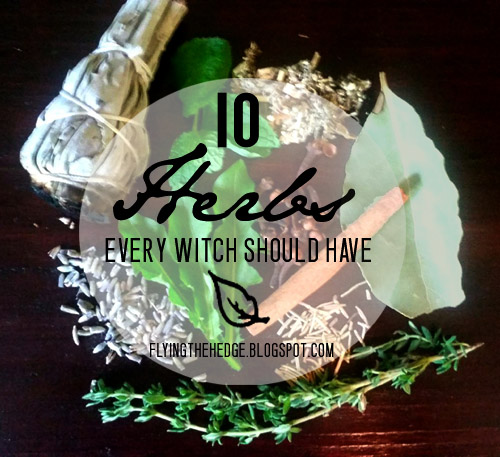
10 Herbs Every Witch Should Have

While you don't need any tools, herbs, or crystals to perform witchcraft, there are some herbs that can enhance your spells and rituals greatly. There are more than a few herbs out there to choose from, so how do you figure out which ones you should keep on hand? Lucky for you, I have done the heavy lifting. Below is a list of 10 herbs every witch should have. Each of the herbs come with suggested alternatives, so if you are unable to find one them or you find the herb doesn't resonate with you, feel free to grab the alternative instead. Please note that the alternatives may not have the exact same magical properties as the original herb, but share many features in common. I suggest researching each to find what works best for your needs.

10 Herbs Every Witch Should Have

10 Herbs Every Witch Should HaveMugwort: This is an absolute MUST have for any witch, especially hedgewitches, due to its unique properties. No other plant has a stronger connection to witchcraft than Mugwort. It is one of the most commonly used herbs in any spell or ritual making it the number one herb to have on hand. Mugwort aids in strengthening psychic powers, prophetic dreaming, and astral projection and can also be used for protection and healing. Use it during rune casting, tarot, palm, tea leaf reading, or any other form of divination to increase your psychic awareness. To learn more, read my Herbarium: Mugwort postSuggested Alternative Herb: Marijuana or Tobacco or Skullcap or Wormwood.
10 Herbs Every Witch Should HaveSage: Of course, sage made the list. How could sage NOT be on the list? Sage is used in a variety of rituals and spells and is probably the most commonly used herb in witchcraft. There are several species of sage, but white or desert sage tend to be the go-to for most witches. However, wild desert and white sage are being harvested at alarming rates and are part of a closed culture and therefore not available for all witches. Use regular kitchen sage to cleanse and purify magical tools, runes, oracle cards, crystals, your home, you name it. Sage can also be used to banish negativity and attract positive energy and vibrations. Sage is also used to enhance learning, knowledge, and wisdom, and is believed to be an anti-aging elixir.  To learn more, read my Herbarium: Sage postSuggested Alternative Herb: Angelica or Bay or Dandelion Leaf.

10 Herbs Every Witch Should HaveBay: Bay leaves come from a shrub, often mistaken as a tree, from the Mediterranean regions of Europe. It is a very common staple in most spice cabinets, and its magical uses are just as versatile. It is often brewed in a tea to enhance clairvoyance and wisdom or induce prophetic dreaming. Bay is also wonderful for protection spells and purification rituals, making it as versatile as the crystal quartz. Some witches write wishes on bay leaves and burn them to help them manifest. Whatever you use bay for, it is a must-have in any witch's cabinet.  Suggested Alternative Herb: Angelica or Camphor or Sage.
10 Herbs Every Witch Should HaveRosemary: "Always throw spilled salt over your left should. Keep rosemary by your garden gate. Add pepper to your mashed potatoes. Plant roses and lavender for luck. Fall in love whenever you can." If you haven't seen or read Practical Magic then this quote doesn't mean much to you, but if you have, you know exactly what I am talking about. Everyone else, FOR SHAME! Go correct the problem and come back when you are done. Rosemary is another staple to any witch's cabinet as well as most people's spice cabinet. It is used for protection, purification, healing, and love. As Sally said, plant it by your garden gate or front door to protect your garden/home and attract love. It works great with lavender as well. To learn more, read my Herbarium: Rosemary post. Suggested Alternative Herb: Frankincense
10 Herbs Every Witch Should HaveLavender: Of course next comes lavender. Plant it for luck, combine it with rosemary to attract love, burn it to bring peacefulness to your home, or place it under your pillow to aid in prophetic dreaming. Lavender is an extremely common herb and is used in a variety of magical rituals and spells. Furthermore, the medicinal properties abound, making it an important addition to your magical cabinet. To learn more, read my Herbarium: Lavender post. Suggested Alternative Herb: Rose or Chamomile.

10 Herbs Every Witch Should HaveClove: While I personally don't like cloves, they are commonly used in prosperity and luck spells, making them essential to have on hand. Furthermore, they can be burned to cleanse objects, people, or rooms and increase positive energy. Cloves are also used for protection and mental clarity. Because it is so versatile, many spells and rituals call for cloves and it is great to have on hand in case of a medical emergency such as a toothache! Suggested Alternative Herb: Chamomile or Lavender or Cinnamon.

10 Herbs Every Witch Should HaveCinnamon: Mmmm cinnamon. I do enjoy the smell, but not the artificially flavored treats like gum. Cinnamon is used to enhance spirituality, success, luck, and prosperity and can also be used in healing and protection rituals and spells. It is basically a go-to for most spell work, making it a wonderful addition to the list. Many witches will wear cinnamon or hang it in their homes, especially around Yule, to attract love, money, and prosperity and protect their home and body. Furthermore, cinnamon has great health benefits and is used in most herbal remedies to treat colds and coughs. Suggested Alternative Herb: Dill or Clove
10 Herbs Every Witch Should HaveDandelion: Of all the herbs on the list, I think dandelion is my favorite. It is bright, cheery, fragrant, and incredibly versatile. Furthermore, dandelions are one of the first flowers of spring, making them extremely important to bees. I don't know about you, but I have a thing for bees, and considering their current decline, allowing dandelions to grow in my yard is beneficial to everyone. Dandelion leaf can be used during divination practices, especially those involving the dead, as well as for healing, purification, and removing negativity from your home. The root is also used in divination and spirit calling. As a hedgewitch, dandelion is important to bridging the gap between our world and the spirit world.  Suggested Alternative Herb: Mint or Mullein or Rose Hips.

10 Herbs Every Witch Should HaveThyme: Thyme is another herb common in most kitchens due to its culinary uses, but it also is great for most magical workings. It attracts loyalty, affection, and good opinion from others, making it great for spells and rituals regarding relationships, especially new ones, and interviews. Furthermore, thyme can be used to attract good health, luck and money, banish negativity and purify your home. To learn more, read my Herbarium: Thyme post. Suggested Alternative Herb: Magnolia Flowers or Sweet Pea. 
10 Herbs Every Witch Should Have
Mint: To some, this may seem slightly odd to include on the list. Mint doesn't often appear in spells and rituals, but it should. Mint promotes energy, clears the
mind increases communication, and stimulates the senses. These properties, which are well known and well documented, are why mint should play a bigger role in witchcraft. It is perfect for eating or smelling before performing magical workings to get you "in the mood." Mint also attracts money and business, draws in good spirits, and protects your home.  Suggested Alternative Herb: Oregano or Peppermint or Tangerine.

So that is my list of 10 herbs I think every witch should have. Did I leave off an herb you use often? Disagree with something on my list? Feel free to add your suggestions in the comments!